The Best Grades of Calcium Carbonate Your Guide to Choosing the Right Grade for Every Industry
The best grades of calcium carbonate are what separate an outstanding product from an ordinary one.
This humble mineral works quietly behind the plastic bags, printing paper, paints, and calcium tablets we use every day.
Abundant and affordable, it has become a cornerstone of modern industry because it improves product quality, lowers cost, and gives products distinctive physical and aesthetic properties.
However, many manufacturers overlook the fact that calcium carbonate is not a single, uniform material.
There are dozens of grades that differ in purity, particle size, whiteness, and surface treatment. That is why it matters to identify the most suitable grade for each application, since the right choice can reduce waste and raise the quality of the final product.
Here, we take you on a practical tour of the main industrial sectors so that you can make a more informed and more profitable purchasing decision.
First: The Basics, Why Do Grades Differ?
Calcium carbonate falls into two main types:
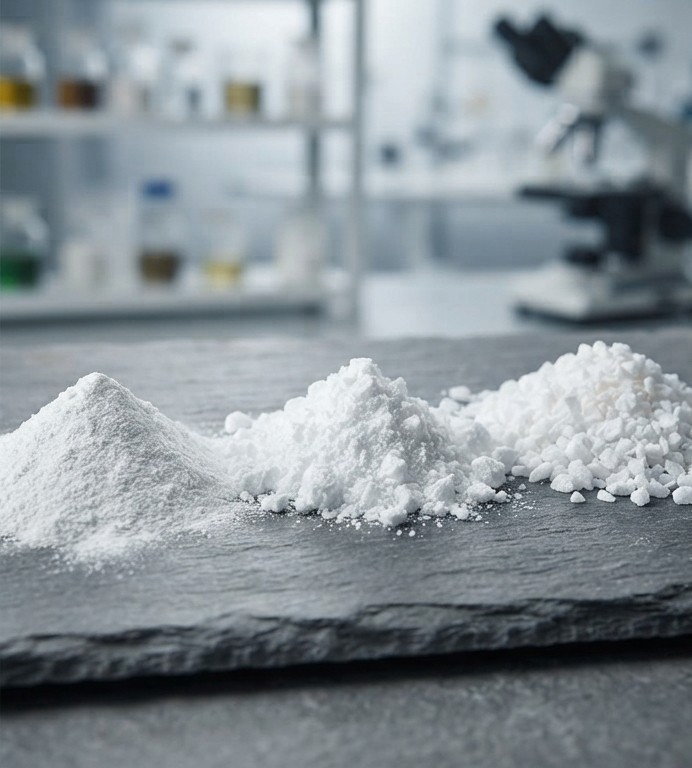
- Ground calcium carbonate (GCC): Extracted from limestone, marble, or chalk, then ground and classified into specific particle sizes. It is valued for its abundance and low cost.
- Precipitated calcium carbonate (PCC): Produced chemically under precise control, yielding particles of uniform shape and size, with higher whiteness and purity.
The quality of any grade is measured by several criteria:
- Purity (CaCO₃ content) and level of impurities.
- Whiteness and brightness.
- Average particle size and distribution.
- Oil absorption and surface area.
- Surface treatment, such as stearic acid coating to improve compatibility with polymers.
It is only natural that the best grades of calcium carbonate differ from one industry to another. What suits paper may not be suitable for pharmaceuticals, and what serves plastics may not suit paints.
Second: Plastics, Rubber, and Cables
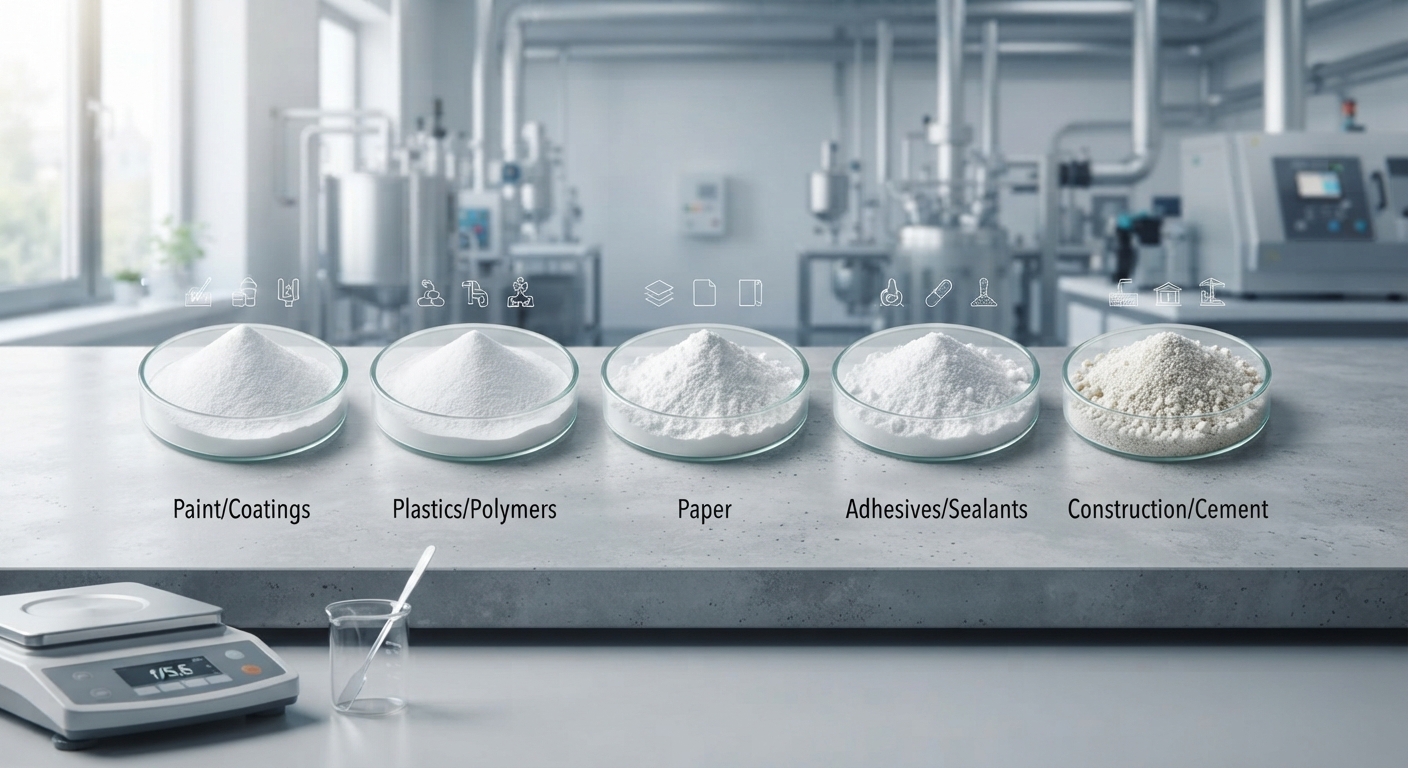
The plastics sector is one of the largest consumers of calcium carbonate, which is used as a filler to reduce the amount of costly resin and improve mechanical properties.
- Required grade: Ground calcium carbonate with a stearic acid surface treatment, to ensure uniform dispersion and reduce moisture absorption.
- Particle size: Fine (about 1 to 3 microns) for films and bags, and slightly coarser for pipes and profiles.
- Benefits: Increased stiffness, improved dimensional stability, faster cooling cycles, and lower overall cost.
- Applications: Masterbatch, PVC pipes, cable insulation, and rubber products.
Be careful with high moisture content in the raw material, as it causes bubbles and surface defects during manufacturing.
Third: Paper and Packaging
In papermaking, calcium carbonate plays two roles: a filler inside the sheet and a coating on its surface.
- As a filler: PCC is preferred because it provides good opacity and bulk and reduces reliance on wood fibers.
- For coating: Ultra-fine ground calcium carbonate is used, usually below 2 microns, to achieve gloss, smoothness, and excellent printability.
- The deciding criterion: High whiteness (ISO above 90) and a narrow particle size distribution.
Here the best grades of calcium carbonate are those that combine high whiteness, precise particle distribution, and suitable viscosity in slurries, which directly improves print quality and reduces ink consumption.

Fourth: Paints and Coatings
In paints, calcium carbonate helps reduce the use of expensive titanium dioxide while giving the coating good coverage and a uniform surface.
- Interior wall paints: Fine grades with high whiteness.
- Water-based paints: Grades with low oil absorption to keep viscosity stable.
- Exterior coatings: Pure grades free of metallic impurities to avoid color changes.
For this reason, manufacturers look for the best grades of calcium carbonate, those that balance covering power, stability, and gloss while keeping unit cost under control.
Fifth: Pharmaceuticals, Food, and Supplements
This is the most demanding sector, as quality here bears directly on human health.
- Grades that comply with pharmaceutical and food specifications: Such as USP, EP, and FCC.
- Purity exceeding 98.5%, with strict limits on heavy metals such as lead, arsenic, and mercury.
- Required certifications: GMP, ISO 22000, and HACCP.
- Uses: Antacids, calcium supplements, fortification of milk and juices, toothpaste, and improving bakery doughs.
In this sector in particular, the best grades of calcium carbonate are determined by the degree of compliance with pharmaceutical standards, traceability records, and strict monitoring of every production batch.
Sixth: Construction, Cement, and Adhesives
In construction, calcium carbonate is used in ready-mix mortars, wall putties, tile adhesives, and filling and insulation materials.
- Grades used: Coarse to medium, selected to improve workability and reduce shrinkage.
- Benefits: Lower cost, higher mix density, and a better final surface texture.
- Most important factor: Consistent particle grading between shipments to ensure uniform performance on site.
Seventh: How Do You Choose the Right Grade for Your Factory?
To avoid costly mistakes, follow these steps:
- Define your application requirements precisely: Whiteness, particle size, purity, and moisture limits.
- Request technical documents: The certificate of analysis (COA) and the technical data sheet (TDS).
- Test samples first: Run small trials before committing to large quantities.
- Verify consistency of quality: Batch-to-batch variation is one of the most serious causes of production line stoppages.
- Evaluate the supplier: Production capacity, delivery speed, packaging quality, and level of technical support.
- Look at the total cost: The cheapest price is not always the most economical, as a good grade can reduce waste and improve the final product.
Frequently Asked Questions:
1. What is the difference between ground (GCC) and precipitated (PCC) calcium carbonate, and which is more suitable for my factory?
Ground calcium carbonate is cheaper and more abundant, and suits plastics, construction, and ordinary paints. Precipitated calcium carbonate offers higher purity, whiteness, and particle-shape uniformity, so it is preferred for high-quality paper, pharmaceuticals, and applications that demand precise performance. The choice depends on the requirements of the final product and the manufacturing budget.
2. Why is calcium carbonate surface-treated with stearic acid?
In its natural state, the particle surface tends to attract water and therefore is not well compatible with polymers. Coating with stearic acid leads to better dispersion within plastics, lower moisture absorption, and improved flow of the mixture and quality of the final surface.
3. What purity is required for pharmaceutical and food uses?
These uses typically require purity above 98.5%, along with strict adherence to heavy-metal limits and compliance with standards such as USP, EP, and FCC. The supplier must provide quality certificates and a traceability record for every batch.
4. How can I verify the quality of a shipment before using it in production?
Request the certificate of analysis (COA) for each batch and compare it with the agreed specifications. Then run quick in-house tests, such as measuring moisture, whiteness, and particle size, and trial a small sample on the production line before using the full quantity.
Conclusion
Calcium carbonate is a simple material on the surface, but behind it lies a world of precision and specialization.
Choosing the best grades of calcium carbonate is not a luxury; it is a strategic decision that shapes the quality of your product, its cost, and the reputation of your brand in the market.
Start by understanding your industry’s needs, invest in reliable suppliers, and do not hesitate to run trials and tests.
The manufacturer who knows exactly what their product needs always stays a step ahead of competitors, and that step may be the result of choosing the right grade of a mineral that seems ordinary.