The Role of Calcium Carbonate in PVC Pipes and Plastic Fittings: The Secret of Durability and Economy
The Role of Calcium Carbonate in PVC Pipes is to give the pipe its stiffness, stability, and reasonable cost all at once. It is an ingredient that works silently inside the walls of the pipes that carry our water and drain our waste, beneath and all around us.
When we look at irrigation, drainage, and plumbing networks, we realize that the quality of these systems begins with fine details in the plastic compound’s formulation, and that choosing the right filler can determine a pipe’s lifespan for decades.
Here we take a practical look at how this material improves performance, what controls ensure the most benefit from it, and we answer the most common questions in this field.
Why Is Calcium Carbonate Added to PVC Compounds?
A pipe compound consists of polyvinyl chloride resin, heat stabilizers, lubricants, and impact modifiers, in addition to the mineral filler.
Calcium carbonate is added in proportions that vary with the pipe type and operating pressure.
The reasons for adding it include:
- Cost reduction: it partially replaces the more expensive resin.
- Increased stiffness: it raises the modulus, giving the pipe better resistance to loads.
- Improved dimensional stability: it reduces shrinkage and distortion after extrusion.
- Better surface appearance: it gives the pipe a smooth, uniform surface.
- Faster cooling: it helps dissipate heat, so production speed increases.
Types Used and Their Properties
Manufacturers rely on three main types:
- Ground Calcium Carbonate (GCC): the most common in pipes thanks to its low price and wide availability of grades.
- Precipitated Calcium Carbonate (PCC): offers higher fineness and greater uniformity, and is used when improved impact resistance is required.
- Surface-treated grades: coated with stearic acid or a similar agent, so they disperse well in the resin and flow easily during extrusion.
The type chosen determines the final performance level, and for this reason The Role of Calcium Carbonate in PVC Pipes remains closely tied to careful selection and the quality of the surface treatment.
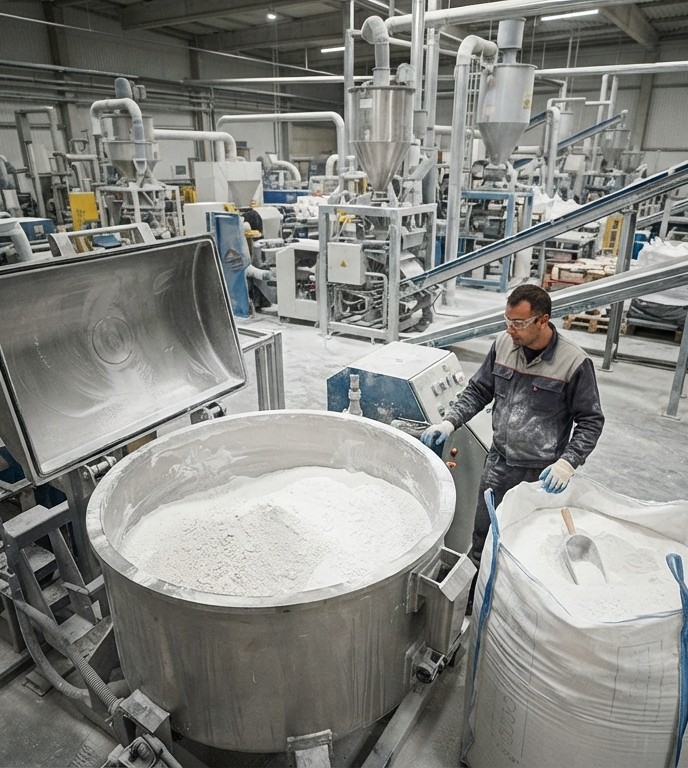
Its Effect on the Pipe’s Mechanical Properties
The material does not behave the same way in every condition, as it affects several properties:
1. Impact Resistance
Fine, well-dispersed particles may improve impact resistance when the loading is controlled. Overloading or the presence of agglomerates weakens the pipe and makes it brittle.
2. Stiffness and Tensile Strength
The material increases stiffness, but raising it beyond the appropriate level reduces tensile strength and elongation. A balance between stiffness and toughness is therefore needed.
3. Pressure Resistance
Pipes designed to carry water under pressure use lower filler levels than drainage pipes, in order to preserve a higher safety margin.
The Role of Calcium Carbonate in PVC Pipes: Technical Criteria for Choosing the Right Grade
When contracting with a supplier, focus on the following indicators, since they turn the material’s function into real performance:
- Particle size and top cut: large particles create weak points from which cracks begin.
- Moisture: high levels cause bubbles and surface defects during extrusion.
- Purity and whiteness: impurities, especially iron oxides, affect color and heat stability.
- Surface treatment: it improves dispersion, lowers viscosity, and protects the machinery.
- Oil absorption: the higher it is, the more lubricant the compound needs.
Fittings and Plastic Connectors
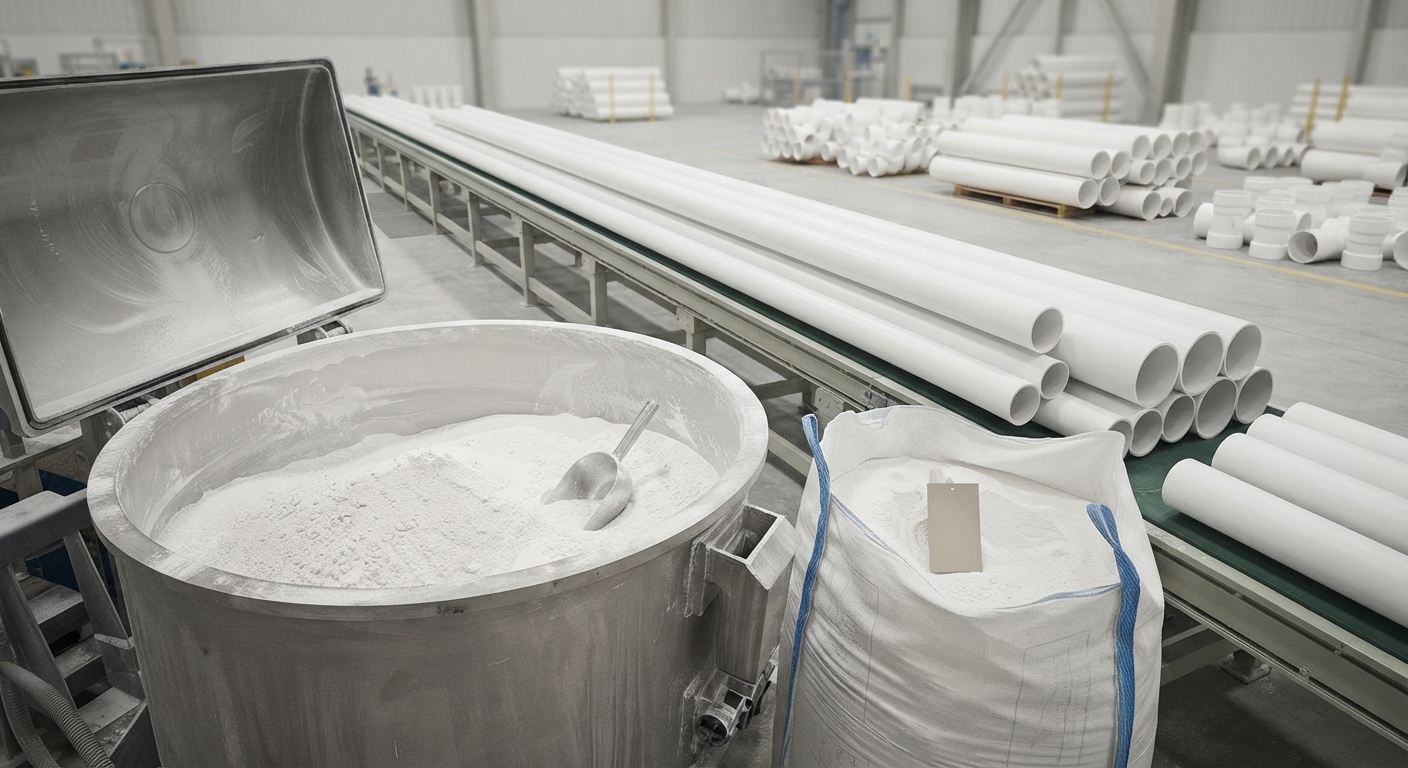
The requirements for fittings differ from those for pipes, as they are produced by injection molding rather than extrusion, and they require good melt flow and dimensional accuracy.
Calcium carbonate is often used here in lower proportions to ensure impact resistance at bends and connection points.
Fine, surface-treated grades are recommended to avoid weld marks and streaks on the surface.
Consistent material quality has a direct effect on dimensional uniformity and on the strength of joints, which are among the areas most prone to leaks.
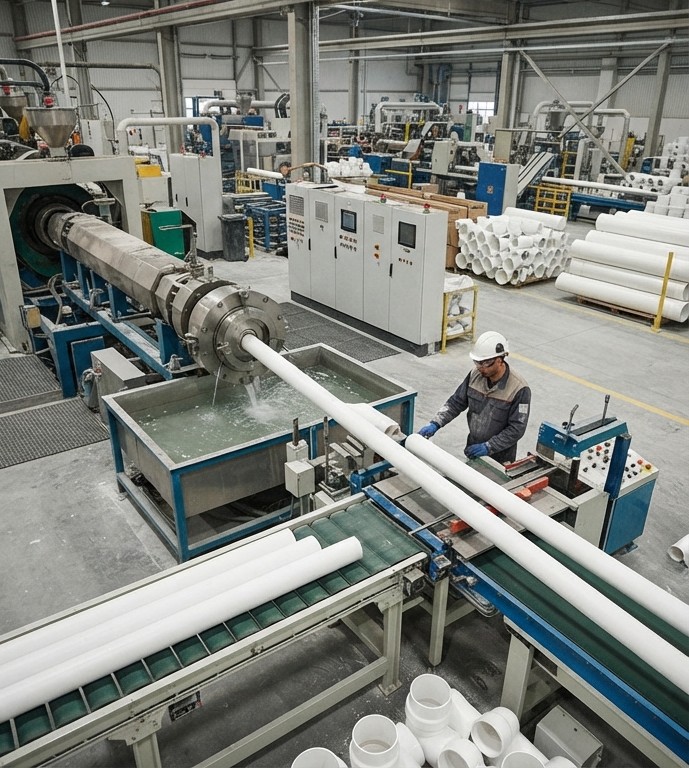
Common Mistakes and Practical Tips
- Approving a grade based on price alone.
- Raising the loading level to cut costs at the expense of impact resistance.
- Neglecting the moisture check on incoming shipments.
- Not running pressure and impact tests on samples from every production batch.
- Ignoring the compatibility of the filler with heat stabilizers and lubricants.
For stable results, it is advisable to work with a supplier that provides a certificate of analysis with every shipment, and to run small-scale trials before full production.
This way, The Role of Calcium Carbonate in PVC Pipes stays positive as long as specifications are carefully considered and loading levels are well controlled.
Future Outlook
The sector is moving toward lighter, longer-lasting pipes, with growing interest in recycling and reducing carbon footprint. This calls for purer, finer, and more stable grades.
The Role of Calcium Carbonate in PVC Pipes is expected to grow stronger through the development of advanced surface treatments that allow higher loading levels while preserving mechanical properties.
Frequently Asked Questions
1. What is the right percentage of calcium carbonate in PVC pipes?
There is no fixed percentage; it changes with the pipe type, operating pressure, and the approved specification. It is usually lower in pressure pipes and higher in drainage pipes. It is best determined through lab and industrial trials in line with local standards.
2. Does calcium carbonate shorten a pipe’s lifespan?
Not if it is used in a good grade and at a well-considered level, as it can maintain dimensional stability and improve performance. Excessive loading or a poor grade containing agglomerates and moisture, however, may cause brittleness and early cracking.
3. What is the difference between its use in pipes and in fittings?
Pipes are produced by extrusion and require stiffness and dimensional stability, while fittings are produced by injection molding and require high flow and greater impact resistance at connection points, so different levels and grades are used in each.
4. How do I verify the quality of a grade before approving it?
Request a certificate of analysis covering particle size, moisture, and purity, then test it in a small production trial, and inspect the resulting pipes through impact, pressure, and surface appearance tests.
Conclusion
It is clear from the above that the success of a plastic pipe does not rest on the resin alone, but on a delicate balance between the components of the formulation, with the mineral filler at the forefront.
A manufacturer who understands The Role of Calcium Carbonate in PVC Pipes and controls its level and specifications gets a more durable product, at lower cost, and better able to compete.
Partnering with a reliable supplier and committing to regular testing is therefore the shortest path to pipes and fittings that earn market trust and last for decades.