How Does Calcium Carbonate Fineness Affect Final Product Quality?
Calcium carbonate is one of the most widely used mineral materials in global industries, entering into the composition of plastics, paints, paper, pharmaceuticals, cosmetics, food products, and more.
In the world of manufacturing , excellence isn’t always measured by what the eye can see .
but by what it cannot , When engineers and manufacturers discuss raw material quality, they’re often referring to properties that can only be detected with precise instruments and measurements foremost among them: particle fineness.
This article takes you on a clear technical journey revealing how the fineness of calcium carbonate makes a real difference in product quality, and how choosing the right fineness grade becomes a strategic decision rather than a mere technical detail.
- What Fineness Grade of Calcium Carbonate Do You Actually Need?
Calcium carbonate is one of the most widely used mineral materials in modern industries, from plastics and paints to paper, pharmaceuticals, and food . What makes it such an influential material isn’t just its chemical composition ; the real secret lies in its particle fineness, which ultimately determines the product’s appearance, texture, performance, and shelf life.
First: What Does “Fineness” Mean, and How Is It Measured?
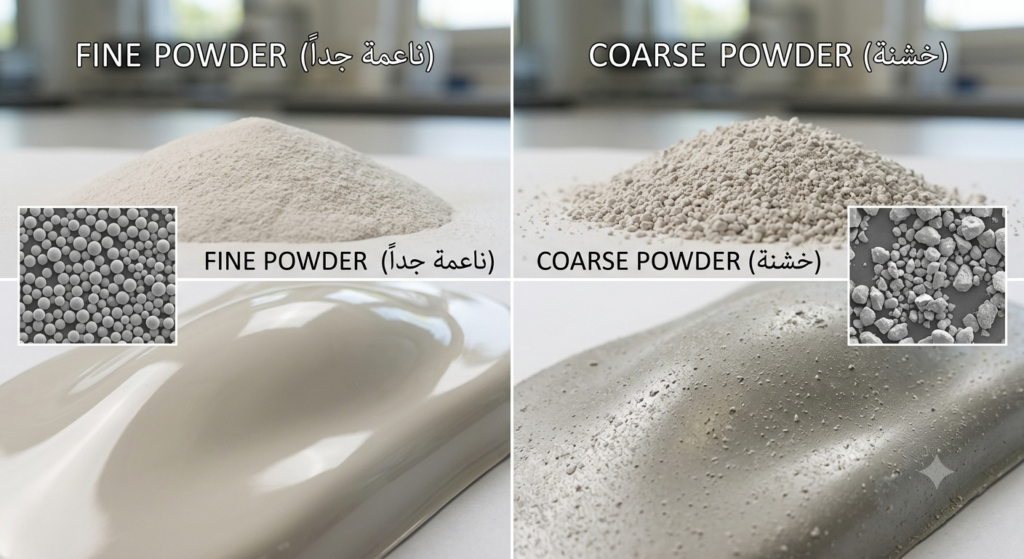
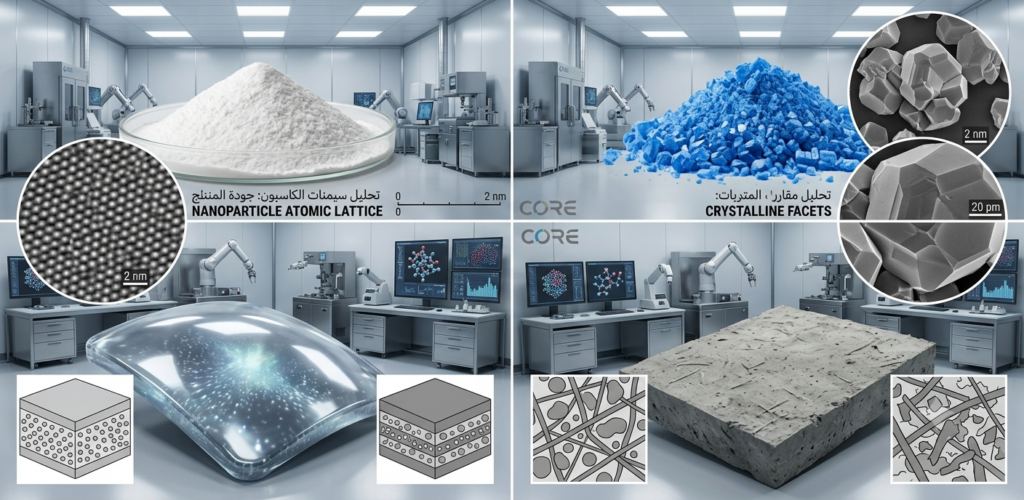
Fineness is a technical term expressing the average particle size of a ground material, usually measured in microns (µm), or expressed via the d50 or d97 coefficient, which indicates the percentage of particles smaller than a given size.
Main Fineness Levels:
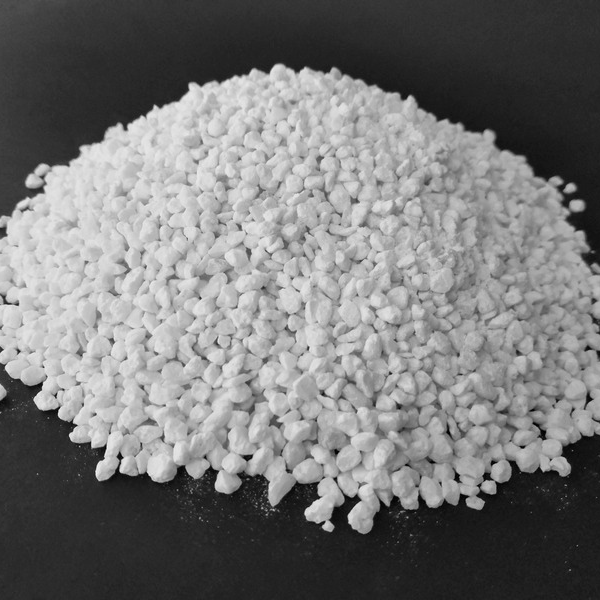
- Coarse (over 45 microns): Used in construction, asphalt, and soil treatment applications.
- Medium (10–45 microns): Common in plastics, rubber, and ceramics industries.
- Fine (2–10 microns): Used in paints, paper manufacturing, and coatings.
- Ultra-fine (under 2 microns): Reserved for food, pharmaceutical, and cosmetic industries.
The smaller the particle size, the greater its specific surface area — and the deeper its impact on the final product’s properties.
Second: The Effect of Fineness on the Product’s Physical Properties :
This is the crux of the entire industrial decision it’s not just about a finer powder, but about fundamental shifts in product performance.
In the paint and coatings industry:
- High fineness in calcium carbonate improves gloss and gives paint a noticeably smoother feel to the touch.
- It reduces microscopic air gaps, enhancing resistance to moisture and corrosion.
- It allows more even pigment distribution, improving surface coverage with smaller quantities.
In the plastics and rubber industry:
- Finer particles distribute more uniformly within the polymer, increasing its mechanical strength.
- They reduce the risk of cracking and breakage, especially in products subject to repeated stress.
- They improve material processability during mixing and extrusion stages.
In the paper industry:
- Gives paper a smooth texture and higher printability.
- Improves brightness and whiteness, a key quality benchmark in this industry.
Third: Fineness and Economic Efficiency Investment or Extra Cost?
Some manufacturers believe that choosing a higher fineness grade necessarily means higher cost without a clear return. This assumption deserves serious reconsideration.
Economic Facts About Choosing the Right Fineness:
- Reduced waste: Calcium carbonate with the appropriate fineness blends more efficiently, reducing the quantities needed to achieve the same performance.
- Lower quality-control rejection rates: Inconsistent products are often caused by variation in particle size — something precise fineness selection addresses.
- Extended machinery lifespan: Coarse particles cause faster wear in mixing and pumping components, while optimal fineness reduces this friction.
- Improved product reputation: Visible and tactile quality smoothness, gloss, and consistency is what customers notice first and remember most.
Fourth: How to Choose the Right Fineness for Your Industry :
There’s no one-size-fits-all answer, but these criteria will guide you toward the right decision:
- Precisely define the end application: Is the product for food use? Industrial? Cosmetic? Each sector has its own specific, approved fineness standards.
- Review customer specifications and international standards: Such as ISO and ASTM standards, which define calcium carbonate specifications for each industry.
- Request Certificates of Analysis (CoA): And verify d50, d97 values, and particle size distribution for each supply batch.
- Run comparative tests: Before committing to a long-term supplier, request samples of different fineness grades and test their actual performance on your production line.
- Consult a specialized supplier: A trustworthy supplier doesn’t just sell material , they provide technical solutions tailored to your industry’s specific needs.
Conclusion :
Practical advice for every industrial buyer:
Choosing calcium carbonate with the right specifications isn’t purely a technical decision, it’s a strategic one that affects your product quality, production efficiency, and customer loyalty.
Practical tip:
The next time you request a quote for calcium carbonate, don’t just ask about price and quantity , ask specifically: What is the particle size distribution? And what is the d50 value for this batch?
This one question sets a professional buyer apart and can save you from costly losses before they happen.
- Quality isn’t built on chance, it’s built on precise selection and deep knowledge.