How to Choose Suitable Calcium Carbonate for Masterbatch Production
Suitable Calcium Carbonate for Masterbatch Production is the foundation on which the success of filler compounds is built, because it determines production stability, final product quality, and profit margin all at once.
Many people assume that any white powder will do, but industrial reality shows that the gap between one grade and another can mean the difference between a uniform film and one full of defects.
Here we put a practical roadmap in your hands to help you make the selection decision with confidence, and we answer the most frequently asked questions in this field.
What Role Does Calcium Carbonate Play in Masterbatch?
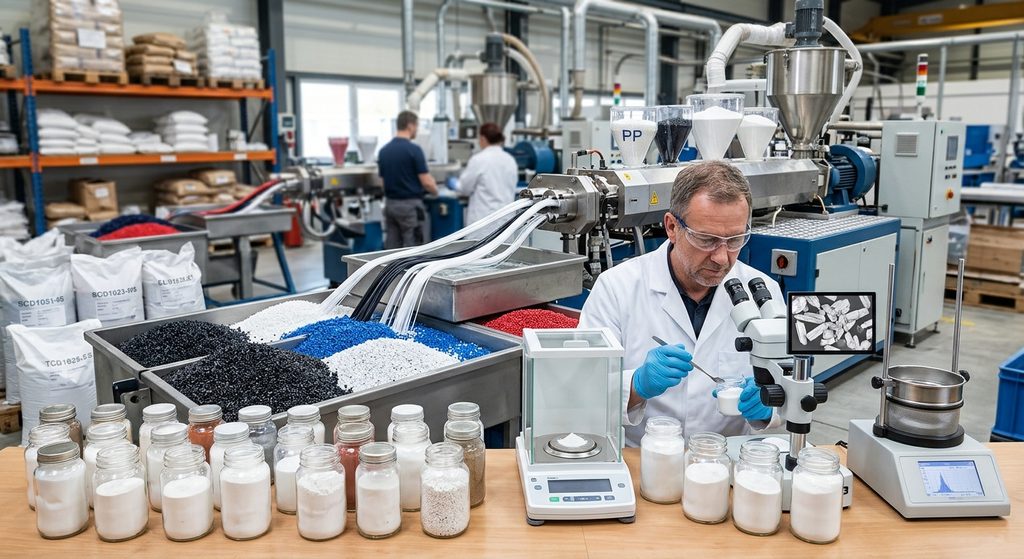
Filler masterbatch is made by mixing a high proportion of calcium carbonate, sometimes 70% or more, with a carrier resin such as polyethylene or polypropylene.
This concentrate is then added to the base polymer during manufacturing. Its benefits include:
- Lowering the cost of the final product by replacing part of the more expensive resin.
- Improving stiffness and dimensional stability.
- Raising whiteness and improving opacity.
- Speeding up product cooling, which shortens the production cycle.
That is why choosing Suitable Calcium Carbonate for Masterbatch Production is not a secondary detail but a decision that affects both economics and quality at the same time.
Available Types on the Market
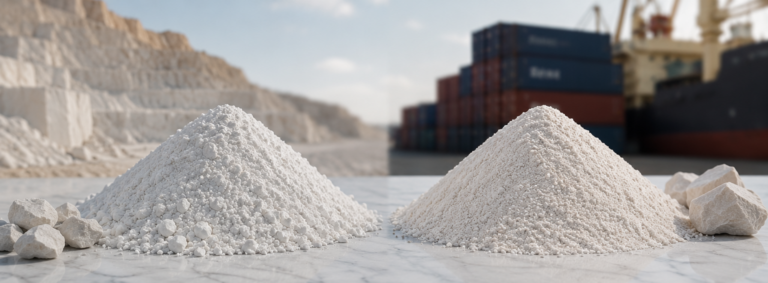
- Ground Calcium Carbonate (GCC): the most widely used option in masterbatch thanks to its low price and availability in many grades.
- Precipitated Calcium Carbonate (PCC): features finer, more uniform particles and is used in applications that need a smoother surface, but it costs more and is harder to load at high levels.
- Surface-treated grades: usually coated with stearic acid, and considered the de facto standard in masterbatch because they are compatible with non-polar polymers.
Technical Criteria for Suitable Calcium Carbonate for Masterbatch Production
When comparing suppliers, focus on the following indicators.
1. Particle Size and Top Cut
The average size determines fineness, but the top cut is the more critical figure. A few oversized particles are enough to cause pinholes or roughness in thin films. A narrow size distribution is preferred.
2. Surface Treatment
Good coating improves dispersion in the resin, reduces agglomeration, and lowers moisture absorption. Poor or excessive coating causes smoke and deposits at the die lip.
3. Moisture
High moisture leads to bubbles, surface streaks, and deteriorated properties. It must be kept as low as possible, with shipments stored in dry conditions.
4. Oil Absorption
The higher the oil absorption, the higher the viscosity, and the harder it is to reach a high loading. Low-absorption grades help raise the filler content without increasing the load on the machine.
5. Whiteness and Purity
Impurities, especially iron oxides, affect color and opacity and may accelerate wear on machine parts.
Matching the Choice to the Application
No single grade suits every use, and the role of Suitable Calcium Carbonate for Masterbatch Production becomes clear when it is matched to the final product:
- Thin films and bags: require fine particles and a very low top cut.
- Injection and molding: tolerate relatively larger particles, with the focus on melt flow.
- Pipes and profiles: rely on grades that deliver stiffness and dimensional stability.
- Fibers and yarns: need the highest levels of fineness and purity to avoid breakage during spinning.
Common Mistakes That Cost Manufacturers Dearly
- Comparing suppliers on price alone.
- Ignoring the Filter Pressure Test, which reveals fine agglomerates.
- Not checking moisture on every incoming batch.
- Raising the loading level without balancing the carrier resin and additives.
- Approving a grade without a small-scale industrial trial on the actual production line.
Experience shows that consistent quality in Suitable Calcium Carbonate for Masterbatch Production is achieved with a supplier who provides a certificate of analysis for every batch and keeps specifications stable from one shipment to the next.

Future Trends
The sector is moving toward thinner, lighter films, with growing pressure to use recycled plastic and reduce carbon footprint. This raises the need for finer, purer, lower-moisture grades, and for fillers compatible with recycled resins. With this evolution, the material remains a strategic component, because investing in its quality gives the manufacturer a long-term competitive advantage.
Frequently Asked Questions
1. What is the highest loading level achievable in masterbatch?
Common levels range between 60% and 80%, depending on the carrier resin, surface treatment, oil absorption, and the mixing equipment used. The finer the particles and the higher the oil absorption, the harder it is to raise the level, so practical trials are recommended before adopting any figure.
2. Why is calcium carbonate surface-treated before use?
Because the carbonate surface is polar while polymers such as polyethylene are non-polar, so the two repel each other. Coating, often with stearic acid, improves compatibility, reduces agglomeration, and lowers moisture absorption, which benefits dispersion quality and processing smoothness.
3. How do I detect dispersion quality in masterbatch?
The best method is the Filter Pressure Test, which measures the pressure rise behind a fine screen as the melt passes through it, and is a direct indicator of agglomerates. It can be supported by visually inspecting thin films for pinholes and rough spots.
4. Is the finest grade always the best?
Not necessarily. Finer particles improve the surface and mechanical properties, but they raise viscosity, increase cost, and limit the loading level. The best choice is the grade that meets the final product’s requirements at the lowest possible cost.
Conclusion
It is clear from the above that the success of masterbatch does not depend on the machine alone, but on the right choice of the raw material that goes into it.
A manufacturer who defines Suitable Calcium Carbonate for Masterbatch Production according to the application type and technical criteria gets stable output, uniform quality, and lower cost.
Building a relationship with a reliable supplier and running regular tests is therefore the shortest path to a product that earns market trust and withstands competition.