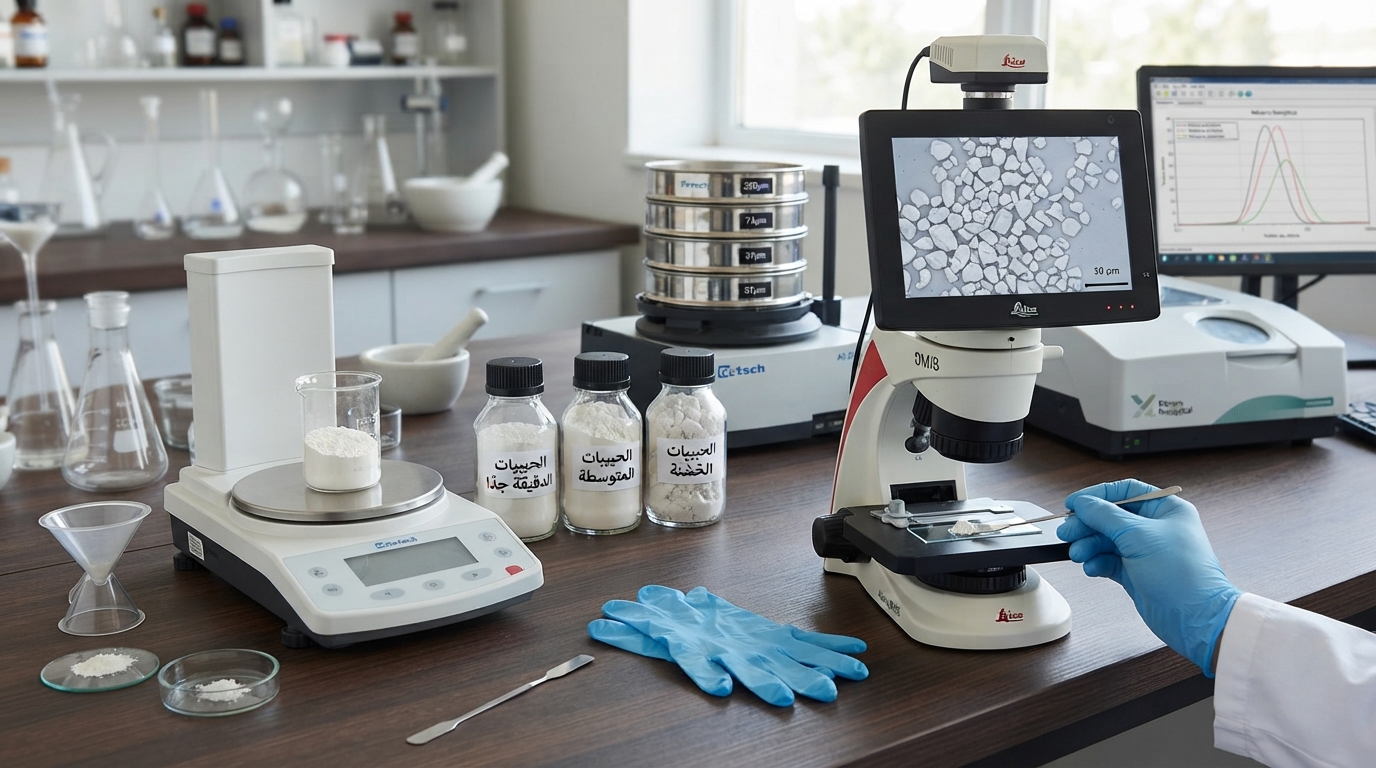
How Do You Choose the Right Particle Size of Calcium Carbonate?
The right particle size of calcium carbonate is the hidden factor that decides whether your product succeeds or stumbles. A raw material may be pure, white, and fully certified, yet still fail on the production line because its particles are larger than they should be or smaller than they need to be.
Many factories buy calcium carbonate on price and purity alone, overlooking that particle size controls gloss, stiffness, flow, energy consumption, and the amount of resin used.
The good news is that the right choice is not a mystery. It is a decision you can make with a clear method.
We explain how particle size is measured, how it affects performance, and which sizes are recommended for each industry, then give you practical steps that help you avoid costly mistakes.
First: What Is Particle Size and How Is It Measured?
Calcium carbonate particles are usually measured in microns (µm), and a micron is one thousandth of a millimeter. Size appears in technical specifications in more than one form:
- Average size (D50): The value below which half of the particles fall and above which the other half lie.
- Upper limit (D97 or Top Cut): The size below which 97% of the particles fall. It reveals the presence of harmful coarse particles.
- Mesh number: Used for coarse grades. Mesh 325 corresponds to about 44 microns.
- Specific surface area: Increases as particles get smaller, and is linked to oil absorption and resin demand.
This is why determining the right particle size of calcium carbonate does not rest on a single number, but on reading the average size, the upper limit, and the particle distribution together.
Second: How Does Particle Size Affect Product Performance?
Fine particles provide:
- A smoother surface and higher gloss.
- Better coverage and opacity in paints and paper.
- Higher toughness and tensile strength in plastics and thin films.
Coarse particles provide:
- Lower oil and resin absorption, which reduces cost.
- Lower viscosity and a higher loading rate in mixes.
- A lower price and less grinding energy.
But every option has a price. Excessive fineness raises the cost and can cause particle agglomeration and higher viscosity, while excessive coarseness can cause surface scratches or pinholes in thin films. The wisdom lies in balancing performance and cost.
Third: Recommended Sizes by Industry
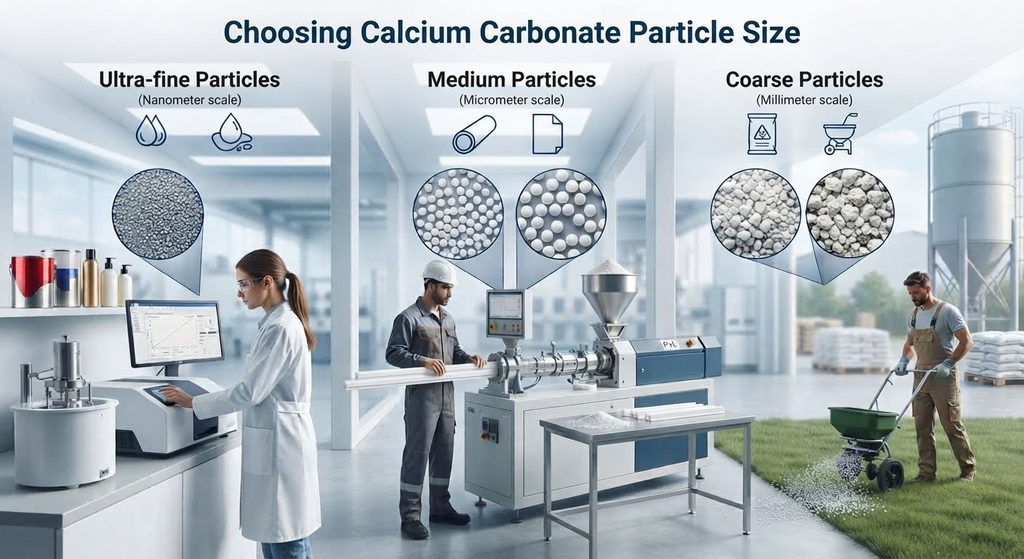
The right particle size of calcium carbonate varies from one industry to another. Below are approximate examples to guide you before you consult your supplier’s specifications:
- Plastic films and bags: Fine grades, about 1 to 3 microns, with a low upper limit to avoid pinholes.
- PVC pipes and profiles: Medium grades, about 2 to 5 microns, surface-treated to improve dispersion.
- Paper (filler): About 2 to 3 microns to achieve good opacity.
- Paper (coating): Ultra-fine grades, usually requiring a large share of particles below 2 microns.
- Paints: From 2 to 10 microns depending on the type of paint and the gloss level required.
- Pharmaceuticals and supplements: Size varies with the tablet manufacturing method, and pharmaceutical specifications must be followed.
- Construction, mortars, and adhesives: Coarse and medium grades, which can reach tens of microns or more, to improve texture and reduce shrinkage.
Fourth: Factors That Shape Your Decision
Knowing the list above is not enough, because some factors are specific to your factory:
- Thickness of the final product: The thinner the product, the smaller the upper particle limit must be.
- Required loading level: The filler ratio is tied to surface area, so fine particles reduce the loading level that is possible.
- Surface treatment: Fine grades need a suitable coating to prevent agglomeration.
- Processing equipment: Some mixers and extruders cannot tolerate the high viscosity caused by very fine particles.
- Budget: Every step toward higher fineness raises the price, so the added performance must justify the difference.
Fifth: Practical Steps for Choosing
When searching for the right particle size of calcium carbonate for a new application, follow this sequence:
- Identify the most important property for your product: Gloss, toughness, cost reduction, or processability.
- Start with the range recommended for your industry, then narrow it through trials.
- Request the technical data sheet (TDS) and make sure it states D50 and D97, not just the average.
- Test at least three grades: One finer and one coarser than expected, alongside the base grade.
- Compare results in practice: Measure viscosity, surface quality, mechanical properties, and the final unit cost.
- Lock the specification with the supplier in a clear contract that defines the permitted tolerances between batches.

Sixth: Common Mistakes to Avoid
- Always choosing the smallest size: Excessive fineness costs more and can hurt flow.
- Ignoring the upper particle limit: A small share of coarse particles is enough to ruin a thin film or a glossy surface.
- Comparing prices without comparing distribution: Two grades with the same average can perform completely differently.
- Neglecting batch consistency: Variation in distribution from one shipment to another is among the most common causes of recurring problems.
- Testing on a single sample: It may not represent actual production, so ask for samples from different batches.
Frequently Asked Questions
1. What is the right particle size of calcium carbonate for thin plastic films?
Films usually suit fine grades with an average of about 1 to 3 microns, with a low upper limit that prevents pinholes and scratches. It is best if they are surface-treated to ensure uniform dispersion.
2. Is the smaller size always better?
No. Finer particles improve gloss and coverage, but they raise the price and viscosity and require more resin. The best size is the one that meets your product’s specifications at the lowest possible cost.
3. What is the difference between D50 and D97, and why do both matter to me?
D50 is the median particle size, meaning half of the particles in the batch are smaller and half are larger. D97 is the upper limit of the distribution, the size below which 97% of the particles fall, and it reveals the coarse particles in the batch. Relying on D50 alone can hide these particles, leading to defects in thin or glossy products, such as pinholes in films and scratches on surfaces. That is why both values should be read together.
4. How do I verify particle size before buying a large quantity?
Request the certificate of analysis (COA) for the batch and compare it with the specification, then test samples on the production line. You can also use a laboratory to measure the distribution by laser diffraction if the specification is critical.
Conclusion
Calcium carbonate looks like a single material, but its performance changes as its particle size changes. Choosing the right particle size of calcium carbonate is an engineering and economic decision at the same time, one that shapes product quality, production cost, and customer satisfaction.
Start by defining your product’s priorities, compare the distribution and not the average alone, test more than one grade before signing a contract, and agree on a fixed specification with your supplier.
The manufacturer who masters this small detail is the one who gets a better product at a lower cost.